Saturday, 4 April 2015

Mainland Ecuador, 19.03.2015 - 30.03.2015

The serene pacific coast, the mighty Andes and the virid Amazonian rainforest, all packed into one tiny South American nation of Ecuador. Where else would I rather spend a spring break with the plethora of wildlife, especially hummingbirds, photogenic landscapes and rich culture that Ecuador has to offer?

The sweltering sun in the Amazon was quite a contrast from hiking in 6-feet of snow in the Canadian Cascades only a week earlier. Add camping below freezing along the Andean paramos within 2 days to that. Descriptions of landscapes, culture, people, climates and the amazing geography of Ecuador can fill diaries of memories. All that along with fishing piranha, swimming in thermal springs in the Andean foothills, wading through waist-high Amazonian flooded rainforests, eating lemon ants and other crazy Ecuadorian adventures have been captured by Constantin in his entertaining blogpost http://thirld.com/blog/2015/06/04/road-trip-in-ecuador/. 

Places visited:

Mindo
Cayambe-Coca Ecologocal Reserve (from Papallacta)
Yasuni National Park (from Coca)
Sangay National Park (from Banos)
Machalilla National Park including Isla de la Plata (from Puerto Lopez)

The raucous Andean Cock-of-the-rock lek, the mighty Andean Condor, the iconic White-Throated Toucan and the bizarre-looking Hoatzin were definitely the stand-out birds for the trip. Other fascinating species like the Purplish Jacamar, Slaty-Backed Forest-Falcon, White-Chinned Jacamar, Viridian Metaltail, Red-Billed Tropicbird and White-Necked Jacobin made unexpected appearances at various points of the trip, but were pleasant surprises to say the least. 

Birds spotted during the trip:

Blue-Footed Booby
1. Cinereous Tinamou - 1 in Yasuni National Park
2. Blue-Footed Booby - 20+ on Isla de la Plata
3. Nazca Booby - 6 on Isle de la Plata
4. Red-Footed Booby - 3 on Isla de la Plata
5. Anhinga - 2 in Yasuni National Park
6. Magnificent Frigatebird - Hundreds soaring over Puerto Lopez and huge roosting site on Isla de la Plata
7. Brown Pelican - 15 near Puerto Lopez
8. Striated Heron - 1 in Yasuni National Park
9. Roseate Spoonbill - 2 in Yasuni National Park along the Napo river
10. Snowy Egret - 8 in Yasuni National Park
11. Little Blue Heron - 2 in Yasuni National Park
12. Cattle Egret - several throughout grazing pastures in the eastern lowlands
13. Great Egret - 1 in Yasuni National Park
14. Andean Teal - 6 in Cayambe-Coca Ecological Reserve
15. Andean Condor - 1 in Cayambe-Coca Ecological Reserve
16. Turkey Vulture - 3 in Coca and 4 near Puerto Lopez
Nazca Booby
17. Black Vulture - hundreds throughout lowlands
18. Osprey - 1 in Yasuni National Park
19. Swallow-Tailed Kite - 2 in Mindo
20. Common Black-Hawk - 2 in Yasuni National Park
21. Great Black-Hawk - 1 in Yasuni National Park
22. Roadside Hawk - 3 in Mindo
23. Broad-Winged Hawk - 1 in Mindo
24. Slaty-Backed Forest-Falcon - 1 in Yasuni National Park
25. Black Caracara - 2 calls in Yasuni National Park
26. Peregrine Falcon - 1 in Yasuni National Park
27. Bat Falcon - 2 in Yasuni National Park
28. Common Piping-Guan - 3 heard in Yasuni National Park
29. Sickle-Winged Guan - 1 in Mindo
30. Least Sandpiper - 1 in Puerto Lopez
31. Andean Gull - 2 in Cayambe-Coca Ecological Reserve
Magnificent Frigatebird
32. Ruddy Pigeon - 1 in Mindo
33. Ruddy Quail-Dove - 2 in Yasuni National Park
34. Eared Dove - several in Agua Blanca in Machalilla National Park
35. Ecuadorian Ground-Dove - 12 in Machalilla National Park
36. White-Tipped Dove - 1 in Mindo
37. Blue-and-Yellow-Macaw - 2 in Yasuni National Park
38. Scarlet Macaw - 2 in Yasuni National Park
39. Red-and-Green Macaw - 3 in Yasuni National Park
40. Chestnut-Fronted Macaw - 2 in Yasuni National Park
41. Cobalt-Winged Parakeet - hundreds in Yasuni National Park
42. Scarlet-Shouldered Parrotlet - 2 in Yasuni National Park
43. Black-Headed Parrot - 2 calls heard in Yasuni National Park
44. Dusky-Headed Parakeet - 20+ in Yasuni National Park
45. White-Eyed Parakeet - 2 in Yasuni National Park
Roseate Spoonbill
46. Blue-Headed Parrot - 1 in Yasuni National Park
47. Red-Billed Parrot - 8 in Mindo
48. Orange-Winged Amazon - 4 in Yasuni National Park
49. Yellow-Crowned Amazon - 20+ in Yasuni National Park
50. Mealy Amazon - 20+ in Yasuni National Park
51. Squirrel Cuckoo - 2 in Mindo
52. Greater Ani - several in Yasuni National Park 
53. Smooth-Billed Ani - several in Machalilla National Park
54. Groove-Billed Ani - several in Machalilla National Park
55. Hoatzin - 5 in Yasuni National Park
56. Common Potoo - 1 in Mindo
57. White-Collared Swift - several in Cayambe-Coca Ecological Reserve
58. Rufous-Vented Whitetip - 2 in Yasuni National Park
59. White-Necked Jacobin - 1 in Mindo
Eared Dove
60. Rufous-Tailed Hummingbird - 2 in Mindo
61. Green-Crowned Woodnymph - 1 in Mindo
62. Buff-Tailed Coronet - 1 in Mindo
63. Red-Necked Woodpecker - 1 in Yasuni National Park
64. Golden-Headed Quetzal - 3 in Mindo
65. Ringed Kingfisher - 2 in Yasuni National Park
66. Amazon Kingfisher - 1 in Yasuni National Park
67. Blue-Crowned Motmot - 3 in Machalilla National Park
68. White-Chinned Jacamar - 1 in Yasuni National Park
69. Purplish Jacamar - 1 in Yasuni National Park
70. Red-Headed Barbet - 1 in Mindo
71. Black-Fronted Nunbird - 5 in Yasuni National Park
72. White-Fronted Nunbird - 2 in Yasuni National Park
73. Pale-Mandibled Aracari - 3 in Mindo
Scarlet Macaw
74. White-Throated Toucan - 1 in Yasuni National Park
75. Channel-Billed Toucan - 1 in Yasuni National Park
76. Golden-Olive Woodpecker - 1 in Coca
77. Smoky-Brown Woodpecker - 1 in Mindo
78. Chestnut Woodpecker - 1 in Yasuni National Park
79. Olivaceous Piculet - 1 in Mindo
80. Yellow-Tufted Woodpecker - 2 in Yasuni National Park
81. Plain-Brown Woodcreeper - 2 in Mindo and 1 in Yasuni National Park
82. Cinnamon-Throated Woodcreeper - 1 in Yasuni National Park
83. Ocellated Woodcreeper - 2 in Yasuni National Park
84. Spotted Woodcreeper - 2 in Mindo
85. Streak-Headed Woodcreeper - 1 in Mindo
86. Red-Faced Spinetail - 1 in Mindo
87. Lineated Foliage-Gleaner - 3 in Mindo
Cobalt-Winged Parakeet
88. Scaly-Throated Foliage-Gleaner - 2 in Mindo
89. Buff-Fronted Foliage-Gleaner - 6 in Mindo
90. Pacific Hornero - 1 in Machalilla National Park
91. Tawny Antpitta - 4 in Cayambe-Coca Ecological Reserve
92. Golden-Faced Tyrannulet - 2 in Mindo
93. Yellow Tyrannulet - 1 in Mindo
94. Slaty-Capped Flycatcher - 4 in Mindo
95. White-Crested Elaenia - 2 in Mindo
96. Scale-Crested Pygmy-Tyrant - 1 in Mindo
97. Vermillion Flycatcher - 2 in Machalilla National Park
98. Black Phoebe - 1 in Mindo
99. Drab Water-Tyrant - 8 in Yasuni National Park
100. Cinnamon Attila - 1 in Yasuni National Park
101. Dusky-Capped Flycatcher - 4 in Yasuni National Park
102. Tropical Kingbird - several in Mindo and Yasuni National Park
103. Masked Tityra - 1 in Mindo
Dusky-Headed Parakeet
104. Black-Crowned Tityra - 1 in Yasuni National Park
105. Black-and-White Becard - 1 in Machalilla National Park
106. Plum-Throated Cotinga - 1 in Yasuni National Park
107. Amazonian Umbrellabird - 1 in Yasuni National Park
108. Andean Cock-of-the-rock - 8 in a lek in Mindo
109. Green Manakin - 1 in Yasuni National Park
110. Brown-Chested Martin - 2 in Coca
111. Gray-Breasted Martin - 4 in Coca
112. Blue-and-White Swallow - 8 in Mindo
113. Gray-Breasted Wood-Wren - 2 in Mindo
114. Lesser Greenlet - 2 in Mindo
115. Swainson's Thrush - 1 in Mindo
116. Glossy-Black Thrush - 12 in Sangay National Park
117. Tropical Parula - 2 in Mindo
Red-Billed Parrot
118. Blackburnian Warbler - 2 in Mindo
119. Slate-Throated Whitestart - 1 in Mindo
120. Three-Striped Warbler - 1 in Mindo
121. Bananaquit - 1 in Mindo
122. Golden-Rumped Euphonia - 12 in Mindo
123. Yellow-Bellied Euphonia - 3 in Mindo
124. Green-and-Gold Tanager - 1 in Yasuni National Park
125. Turquoise Tanager - 2 in Yasuni National Park
126. Bay-Headed Tanager - 1 in Mindo
127. Golden Tanager - 1 in Mindo
128. Blue-and-Black Tanager - 1 in Yasuni National Park
129. Scarlet-Bellied Mountain-Tanager - 1 in Papallacta
130. Blue-Gray Tanager - 5 in Mindo
131. Lemon-Rumped Tanager - 8 in Mindo
132. White-Shouldered Tanager - 1 in Mindo
133. Yellow-Throated Bush-Tanager - 7 in Mindo
Mealy Amazon
134. Southern Yellow-Grosbeak - 2 in Machalilla National Park
135, Variable Seedeater - 1 in Mindo
136. Yellow-Bellied Seedeater - 1 in Mindo
137. Black-Striped Sparrow - 1 in Mindo
138. Pale-Naped Brush-Finch - 2 in Cayambe-Coca Ecological Reserve
139. Paramo Pipit - 2 in Cayambe-Coca National Park
140. Rufous-Collared Sparrow - 2 in Quito
141. Long-Tailed Mockingbird - several in Machalilla National Park
142. Yellow-Rumped Cacique - 1 in Machalilla National Park
143. Crested Oropendola - several in Yasuni National Park
144. Russet-Backed Oropendola - 8 in Yasuni National Park
145. Red-Breasted Blackbird - 3 in Machalilla National Park
146. Peruvian Blackbird - 1 in Machalilla National Park
147. Scrub Blackbird - many in Machalilla National Park
148. Stout-Billed Cinclodes - 8 in Cayambe-Coca Ecological Reserve
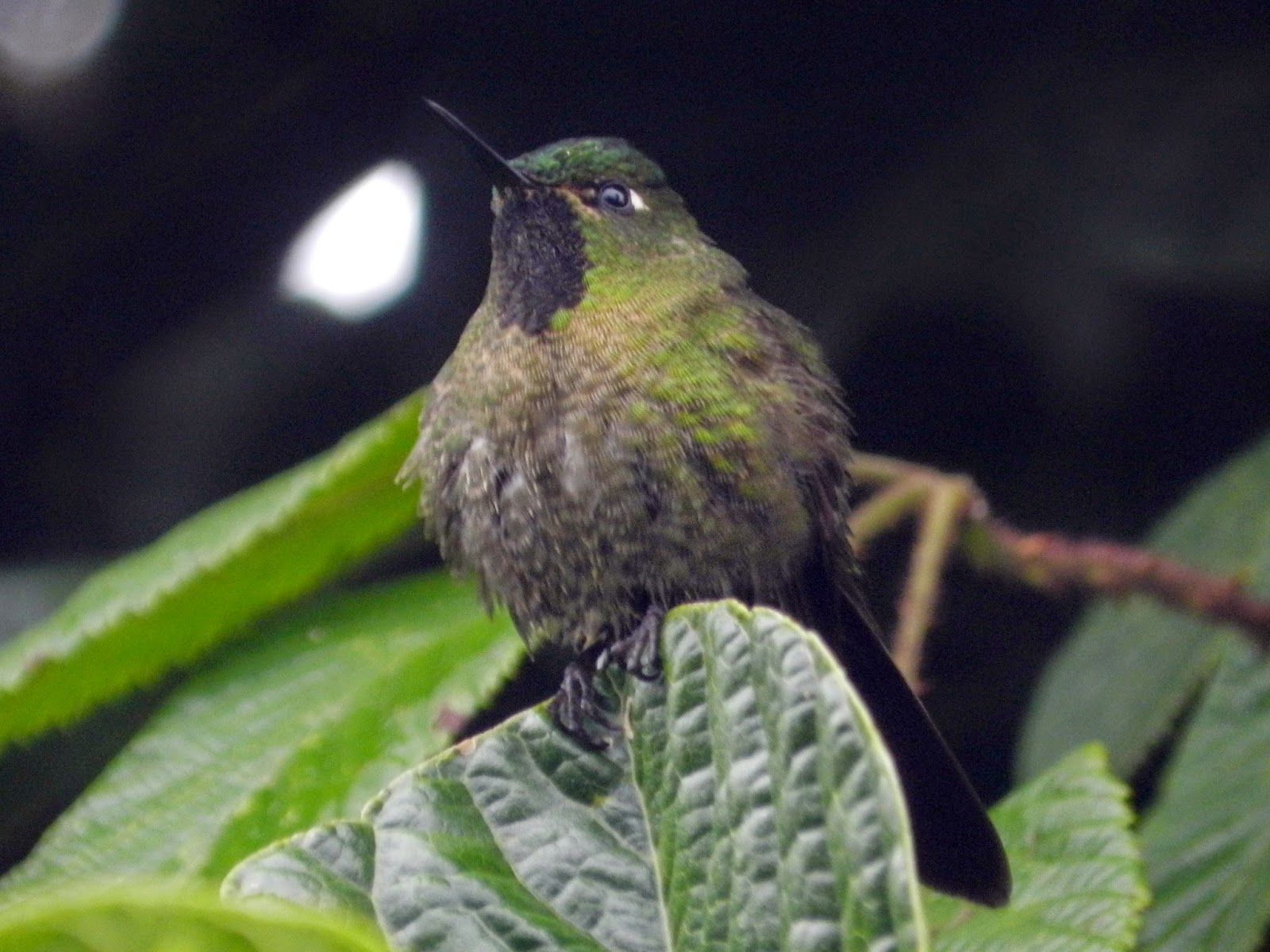
149. Viridian Metaltail - 1 in Sangay National Park

Hoatzin


Common Potoo


Viridian Metaltail


Golden-Headed Quetzal


Red-Headed Barbet


White-Fronted Nunbird


Plain Brown Woodcreeper


Vermillion Flycatcher


Black-and-White Becard


Andean Cock-of-the-rock


Brown-Chested Martin


Variable Seedeater


Most trips in Ecuador can be done without guides and tours, unlike popular belief, if it is given a little thought and planning. Of course, coming straight out of Canada I had put in no thought or effort into planning, but found out ways of doing everything alone. 

Yasuni National Park - Get a ferry from Coca to Nuevo Rocafuerte. Either atNuevo Rocafuerte, or the town before it (name starts with a P), one can find lodging for about $10 a night with a local tribe. This is a much better experience than taking a tour! Luckily, I could find a local Kichwa man to take us to Yasuni by boat, but that may not always work out. Once at the village on the Napo river, it is easy to ask a local to take you to different places in Yasuni National Park by boat for sub-$50 price. Do not miss the clay licking of parrots, parakeets and macaws!

Cayambe-Coca Ecological Reserve - Get to Papallacta, a small village tucked away in the cushions of the Andes, and stay at a local's house. We got a little room with a nice thermal spring to swim in which was as pleasant a surprise as any other on a cold rainy evening. The entrance to the reserve is past the Thermas de Papallacta, past a guarded gate and 4km further on a road that could test any car's suspensions. Once into the reserve, you are immersed into a landscape like no other - paramos, interconnected lakes dotted with Andean teal, waterfalls resounding from all sides, beautiful hills and their glimmering reflections in the myriad of lakes and a zephyr wafting through the air.

Machalilla National Park - This is the easiest to enter, but with a little planning. We tried to get in through Julcuy which turned out to be a massive blooper, and we ended up pushing our car through 2 feet of wet mud swirling at our feet - it was bad enough for me to discard my shoes as soon as we made it out of the muddy mess. In short - approach through Puerto Lopez (via Jipijapa if entering from the east). There are clear gates for Agua Blanca which is the park entrance and Los Frailes, which is one of the most amazing beaches I've been to in recent times. From Agua Blanca, you need to be lucky that the little river flowing through has not inundated the village and blocked the entrance to San Sebastian completely. Unfortunately, this happens more often than not and you are only confined to the west of the river that holds a so-called museum with handwritten theories and a knee-deep sulphurous lagoon packed with Gringos like a sardine can. You definitely want the east side of the river with the Incan archaeological;site and the San Sebastian trail.
Isla de la Plata is also a part of this national park and has to be reached through an agency, unfortunately. It is an hour and a half boat ride from Puerto Lopez or Puerto Cayo, but is the only roosting site of the Nazca Booby in Ecuador. Definitely worth the visit, especially if it includes watching sea turtles and snorkeling with piranha.

Mindo - Mindo is just a town famous for its birds, and is very easy to get to. It is right off the mountainous highway from Quito to Santa Domingo (past a few traffic jams, slow-moving lorries and landslides that convert the highway into a stony one-and-a-half-lane camel-ride). We met Alex there who knew the location of an Andean Cock-of-the-rock lek and the (unusually conspicuous) roosting spot of an Andean Potoo. Since Mindo has become famous for its birds, especially aracaris, quetzals and pygmy-tyrants, most people in Mindo know about the birds and can give directions to interesting birding spots. Look for the Black-and-White Owl while in Mindo!

Wednesday, 31 December 2014

Southern Mexico, 17.12.2014 - 29.12.2014

It was the last birding trip of 2014, and the first half of the winter break. It was the time of the year I desperately wanted to go south and escape the chills of winter in Berkeley. I cancelled Costa Rica plans and booked last minute tickets to Cancun, Mexico after discussing with Wojciech, a really smart Polish Physics student at Berkeley. 

Plain Chachalaca

Wojciech joined me a day later in Mexico, and by that time I had already rounded up the commoner birds in Yum Balam National Park with the Blue-Crowned Motmot standing out. We immediately headed out of Cancun to Isla Holbox, which is a 1-hour ferry away from Chiquila. Isla Holbox and especially Isla Pajaros were great nesting sites to spot all types of waders and the Magnificent Frigatebird. We camped on the beach, kayaked through the mangroves and swam pretty far from the coast in shallow seas. Overall, Isla Holbox is one of those places none of the Americans seem to know about, but the Europeans love - it is quiet, small, not rampaged by tourists every year, but has enough to sustain a decent vacation.


Altamira Oriole
Once we were done with Holbox, we decided to explore Yum Balam National Park from its western side through Solferino. We found out Gilberto, locally known as Gilapa, was the expert in the town. With nothing but the name, we tracked Gilberto down in the most ridiculous fashion - I drove from house to house, and Wojciech jumped out and crashed every house asking for our man. Victims included an old woman cooking dinner, a drunk girl, a construction worker and a restaurant owner. We finally blocked Gilapa's path as he was parking his white minivan and told him about our request to see birds. Surprised, bemused, but also excited, he readily agreed and we found a back-country way into the forests. The day started with a decent view of the Keel-Billed Toucan followed by several forest specialties and a juvenile Crane Hawk, which the three of us took about twenty minutes to identify. Gilapa saw his first Canivet's Emerald, with which he was quite excited and then we immediately tracked down a Collared Micrastur from its call. Overall, pretty decent birding. Gilapa also showed us his efforts for conservation and photographs of Jaguars, Ocelots, Margays, Pumas and Ocellated Turkeys from the park.

Bare-Throated Tiger-Heron

We left late in the evening in heavy rain. Seemed right to give an enthusiastic Wojciech some driving lessons. So Wojciech learnt to drive a manual car without power steering in the middle of a mexican jungle in heavy rain and dimming light. He did fairly well. That took us to Merida, since we reached Chichen-Itza too late. Not that either of us cared about the tourist trap.


After downing several tacos, empanadas and other typical Mexican street food, we left for Miguel Colorado. The only reason being a Cenote, or a sinkhole, which was not overflowing with tourists, was in a middle of a jungle and had clear water with fish. Little did we know we could also zipline! We got pretty late so we tried to crash on an old village road, only to wake up a bewildered family with barking dogs, We quickly escapes the scene and crashed in the car on a deserted road leading to a ranch. 

Barred Antshrike (female)
At Miguel Colorado, we met Raul, and by that time we had picked up broken Spanish through
Wojciech's Spanish tutorials in the car. We tried to use our broken Sanish but thoroughly confused Raul. That is when Bronco heard us and helped us out. Bronco was a typical US-returned Mexican. He was back after a 19 year drug-dealing cum contract-killing stint in Nebraska, and was now happily married in Escarcega with a wife and three kids. He was now a philanthropist. With Bronco's help we convinced Raul to leave us deep into the forest overnight and take us to the lake the next day. We did exactly that - camped at the edge of an untrodden sinkhole, from which at least a million bats rushed out in huge spirals at 6 pm. Bat Hawks lined the trees as the bats were surging out and they all grabbed meals before flying off. The bats were followed by a dozen Barn Owls and we heard Ferruginous Pygmy-Owls and Eastern Screech-Owls hoot the onset of night. 

Black-Bellied Plover (winter plumage)
The next day we birded around the sinkhole and we saw an adult Crane Hawk finally. A Grey Fox, wild papayas (which were indeed quite tasty) and three more hidden cenotes rounded up the morning's adventures. As if we hadn't been through enough mosquito trouble already, we gulped down three entire fish and moved on to the lake in the middle of the jungle. Middle of the jungle meant an hour's motorcycle ride with Raul and his friend Anthony from Miguel Colorado. And of course we got eaten alive by mosquitoes again. But it was totally worth it - Spider Monkeys, Collared Trogons, Black-Headed Trogons, a White-Striped Woodcreeper and a Dusky Hummingbird made appearances in the middle of the day. The lake was shrouded in tranquility and the view was breathtaking.

Black-Cheeked Woodpecker
After discovering that Raul had his own Mayan ruins in his ranch and that his mother was a Mayan speaker herself, we bid farewell to a teary Raul, his family, their pug Athenas and a Red-Lored Parrot as we made our way to Palenque in Chiapas. The Palenque ruins were beautiful beyond description and a noisy group of Black Howler Monkeys made up for the lack of wildlife for the day. After pouring through the descriptions of Mayan culture and tradition, we headed off to Montes Azules National Park - our aim was to camp in the middle of the cloud forests and wake up to the calls of Resplendant Quetzals and Scarlet Macaws. We had no idea what we were getting into!

Black-Headed Saltator

As we were driving along the untarred route to Montes Azules from the western side, we were

stopped by two drunk teens looking for a ride to their village. Of course we gave them a ride and, luckily enough, we they warned us about threas on the road like burglars and wild animals. We decided to call it a night since it was pretty much midnight and we crashed outside our new friends' home. We had no idea where we were or what we would do next. Every day was a mystery unfolding in front of us.

The next day we left for the national park and, this time, we approached it from the right side through Benemerito and Chajul. We were onto our second manhunt. A few inquiries yielded a name Pepe who had a boat and could possibly take us across the river into the jungle. We asked shopkeepers, housewives, kids on streets and even a man on his roof (no idea what he was up to) and finally tracked down Pepe. As expected he was surprised by our request, and luckily his charming daughter helped translate both ways. Within 15 minutes we were in a boat crossing the Rio Lacantun to the midst of the National Park. Pepe and his daughter were more scared than us as we had no idea what we were signing up for. Camping in the cloud forests. Sounded pretty awesome.

Blue Grosbeak

It was only after we were left alone in the densest of vine-tangled jungles shrouded in darkness that we felt the pinch. It was not just scary - it was creepy and the entire jungle was springing to life - mammals of all types were waking up, and so were the snakes, giant spiders and nighthawks. We set up camp and sat inside trembling at the thought of an approaching jaguar. Sure enough the Jaguar came by at around midnight, to drink from the river. Wojciech heard growling and I heard footsteps throughout the night. Neither of us slept well - we were continuously plotting escape routes and defense strategies in our minds as the possibility of a Jaguar attack loomed larger. 


Blue-Crowned Motmot
As soon as the sun rose, we discussed how lucky we were to survive the night and vowed never to take such a big risk again. The morning proved extremely fruitful as we spotted Montezuma Oropendolas, Collared Aracaris, Russet Antshrikes, Long-Tailed Hermits and Black-Cheeked Woodpeckers among many other species. Once we crossed back to Chajul and related our stories, even Pepe agreed never to let anyone in the jungle overnight. A new unwritten law had been passed in Chajul.

We made our way out of Chajul, only to find our car leaking motor oil at the rate of the Victoria Falls. A garage on the border of Guatemala was our only hope as they replaced a faulty oil filter with another faulty one, with Florenzo claiming it would only last a day. We got the right filter at Benemerito and I drove 12 hours straight to Merida. We finally made it into Chichen-Itza, which was as touristy as we had imagined, and then headed to Tulum. A full day's worth of snorkeling in sinkholes, coastal reefs and bays followed and we swam with sea turtles and rays. Of course I lost my glasses in the process (i wonder how I'm gonna explain losing my glasses in a Mexican sinkhole to my parents) and I wore Wojciech's glasses to drive while he used his optically corrected snorkel mask. Yes, we looked ludicrous, but that was the only solution!

A list of all the birds spotted on the trip:

Crane Hawk (juvenile)
1. American White Pelican - several around Isla Holbox and Isla Pajaros
2. Brown Pelican - several at Isla Holbox
3. Double-Crested Cormorant - 12 at Isla Holbox
4. Neotropic Cormorant - many at Isla Holbox
5. Magnificent Frigatebird - many at Holbox and Chiquila
6. Bare-Throated Tiger-Heron - 1 at Holbox while kayaking through mangroves
7. Great Blue Heron - several including one in white morph at Holbox
8. Great Egret - many around Holbox
9. Little Blue Heron - many around Holbox
10. Reddish Egret - 3 at Isla Pajaros
11. Cattle Egret - 3 in Miguel Colorado
12. Green Heron - 2 in Holbox
13. Black-Crowned Night Heron - 2 in Holbox
14. White Ibis - 4 in Holbox while kayaking
15. Wood Stork - 1 in Holbox
Great Blue Heron (white morph)
16. Black Vulture - Hundreds everywhere
17. Turkey Vulture - Many throughout Mexico
18. Savanna Vulture - 2 at Chajul
19. Osprey - 2 in Holbox
20. White-Tailed Kite - 1 near Solferino
21. Crane Hawk - 1 juvenile in Yum Balam, 1 adult in Miguel Colorado
22. Common Black-Hawk - 2 in Yum Balam
23. Gray Hawk - 3 in Yum Balam
24, Roadside Hawk - 2 in Yum Balam
25. Collared Micrastur - 1 in Yum Balam
26. Laughing Falcon - 1 calling in Yum Balam
27. Bat Falcon - 4 in Miguel Colorado near the sinkhole with bats
28. Plain Chachalaca - 6 in Yum Balam
29. Montezuma Quail - 2 in Montes Azules
30. Limpkin - 2 in Holbox
31. Black-Bellied Plover - 2 in Holbox
32. Spotted Sandpiper - 2 in Holbox
33. Pectoral Sandpiper - 1 in Holbox
Gray Saltator
34. Ruddy Turnstone - 5 in Holbox, 1 in Chiquila
35. Western Sandpiper - 2 in Holbox
36. Ring-Billed Gull - 2 in Holbox
37. Herring Gull - 1 in Holbox
38. Bonaparte's Gull - many in Holbox
39. Royal Tern - many in Holbox
40. Sandwich Tern - many in Holbox
41. Blue Rock Dove - many in towns
42. Red-Billed Pigeon - 4 in Yum Balam
43. Mourning Dove - many in Holbox
44. White-Winged Dove - 4 in Yum Balam
45. Common Ground-Dove - 2 in Yum Balam
46. Ruddy Ground-Dove - many especially near the Guatemala border
47. Blue Ground-Dove - 2 near Guatemala border
48. Grey-Chested Dove - 1 in Palenque
49. Ruddy Quail-Dove - 2 in Montes Azules
50. Green Parakeet - 5 in Miguel Colorado
Gray Hawk
51. Aztec Parakeet - many in Solferino
52. Orange-Chinned Parakeet - 3 at Chajul
53. White-Fronted Parrot - 1 in Miguel Colorado
54. Red-Lored Parrot - 1 in Miguel Colorado
55. Squirrel Cuckoo - 4 in Holbox, 1 in Miguel Colorado
56. Smooth-Billed Ani - several in Miguel Colorado
57. Groove-Billed Ani - many in the entire countryside
58. Barn Owl - 12 at Miguel Colorado coming from the sinkhole
59. Eastern Screech-Owl - 2 calling at Miguel Colorado
60. Ferruginous Pygmy-Owl - 1 calling at Miguel Colorado
61. Common Nighthawk - 1 in Montes Azules
62. White-Collared Swift - 2 in Miguel Colorado
63. Long-Tailed Hermit - 1 in Montes Azules
64. Dusky Hummingbird - 1 in Miguel Colorado
Keel-Billed Toucan
65. Buff-Bellied Hummingbird - 1 in Yum Balam
66. White-Bellied Emerald - 1 in Montes Azules
67. Canivet's Emerald - 1 in Yum Balam
68. Black-Headed Trogon - 2 in Miguel Colorado
69. Collared Trogon - 2 in Miguel Colorado
70. Blue-Crowned Motmot - 1 in Yum Balam
71. Turquoise-Browed Motmot - 1 in Montes Azules
72. Blue-Throated Motmot -1 in Montes Azules
73. Green Kingfisher - 1 in Montes Azules
74. Emerald Toucanet - 1 in Palenque
75. Collared Aracari - 1 in Montes Azules
76. Keel-Billed Toucan - 1 in Yum Balam, 2 in Montes Azules
77. Black-Cheeked Woodpecker - 2 in Montes Azules
78. Golden-Fronted Woodpecker - 1 in Yum Balam
79. Yucatan Woodpecker - 1 in Yum Balam
80. Pale-Billed Woodpecker - 1 in Montes Azules
Magnificent Frigatebird
81. Ruddy Leafgleaner - 2 in Montes Azules
82. Laughing Woodcreeper - 1 in Montes Azules
83. White-Striped Woodcreeper - 1 in Miguel Colorado
84. Barred Antshrike - 3 in Yum Balam, 1 in Montes Azules
85. Russet Antshrike - 1 in Montes Azules
86. Greenish Elaenia - 1 in Yum Balam
87. Yellow-Bellied Elaenia - 1 in Yum Balam
88. Tufted Flycatcher - 1 in Montes Azules
89. Vermillion Flycatcher - 3 in Yum Balam
90. Rufous Mourner - 2 in Montes Azules
91. Great Kiskadee - 3 in Yum Balam
92. Boat-Billed Flycatcher - 1 in Yum Balam
93. Social Flycatcher - many everywhere
94. Tropical Kingbird - 3 in Yum Balam
95. Western Kingbird - 1 in Yum Balam
96. Cassin's Kingbird - 1 in Yum Balam
97. Rose-Throated Becard - 1 in Montes Azules
98. Mangrove Vireo - 1 in Holbox
Osprey
99. Green Jay - 3 in Miguel Colorado, 1 in Montes Azules
100. Brown Jay - several in Miguel Colorado, Yum Balam and Montes Azules
101. Yucatan Jay - several in Yum Balam
102. Unicolored Jay - 1 in Montes Azules
103. Common Raven 1 in Montes Azules
104. Tree Swallow - many in Holbox
105. Northern Rough-Winged Swallow - 3 in Yum Balam
106. Brown Creeper - 1 in Montes Azules
107. Wood Thrush - 1 in Montes Azules
108. Louisiana Waterthrush - 1 in Holbox
109. Gray Catbird - 2 in Yum Balam
110. Black Catbird - several in Yum Balam
111. Tropical Mockingbird - many throughout Mexico
112. Blue-Winged Warbler - 2 in Yum Balam
113. Yellow Warbler - 2 in Holbox
114. Mangrove Warbler - 2 in Holbox
115. Yellow-Rumped Warbler - 3 in Yum Balam
Painted Bunting
116. Black-Throated Green Warbler - 2 in Yum Balam
117. Pine Warbler - 1 in Yum Balam
118. Black-and-White Warbler - 2 in Yum Balam
119. American Redstart - 2 in Holbox
120. Prothonotary Warbler - 1 in Yum Balam
121. Common Yellowthroat - several in Yum Balam
122. Gray-Headed Tanager - 1 in Yum Balam
123. Rose-Throated Tanager - 3 in Yum Balam
124. White-Winged Tanager - 1 female in Montes Azules
125. Yellow-Throated Euphonia - 4 in Holbox
126. Yellow-Faced Grassquit - 5 in Yum Balam
127. Blue-Black Grassquit - 1 in Yum Balam
128. Olive Sparrow - 2 in Yum Balam
129. Gray Saltator - 4 in Yum Balam, 2 in Montes Azules
130. Buff-THroated Saltator - 2 in Yum Balam
131. Black-Headed Saltator - 2 in Yum Balam
Roadside Hawk
132. Black-Faced Saltator - 1 in Montes Azules
133. Blue-Black Grosbeak - 4 in Yum Balam
134. Blue Grosbeak - 2 in Miguel Colorado
135. Rose-Breasted Grosbeak - 6 in Miguel Colorado
136. Yellow Grosbeak - 1 in Yum Balam
137. Northern Cardinal - 4 in Yum Balam
138. Painted Bunting - 1 in Miguel Colorado
139. Singing Blackbird - 3 in Yum Balam
140. Great-Tailed Grackle - Hundreds in Cancun
141. Bronzed Cowbird - 3 in Miguel Colorado
142. Wagler's Oriole - 2 in Yum Balam
143. Hooded Oriole - 2 in Montes Azules
144. Yellow-Tailed Oriole - 1 in Yum Balam
145. Altamira Oriole - 6 in Yum Balam
146. Yellow-Billed Cacique - 3 in Montes Azules
147. Montezuma Oropendola - 2 in Montes Azules
148. Black-Headed Siskin - 2 in Yum Balam
149. Lesser Goldfinch - 1 in Yum Balam
150. Lawrence's Goldfinch - 3 in Yum Balam

Until next time!

Royal Tern


Ruddy Turnstone


Sandwich Tern


Social Flycatcher


Squirrel Cuckoo (juvenile)


Vermillion Flycatcher


Yucatan Jay


Yucatan Woodpecker


Canivet's Emerald

Tuesday, 11 November 2014

Launching Project AviPulse : Technology for Bird Conservation

After several months of relentless efforts by Bhavin Chandarana, Pallavi Hujband and myself, Project AviPulse www.avipulse.com has finally launched! I have always wanted to give back to nature nad to the avian fauna the world offers - And the time has come. Project AviPulse has emerged out of a passion for birds, birdwatching, ornithology and now bird conservation.


Project AviPulse aims to improve bird conservation through:
  • Creation of knowledge
  • Generation of awareness
  • Appropriate use of technology
We implement cutting edge technology, through collaborations with research institutes like IIT Madras and IIT Bombay, that aid in census, bird identification and bird conservation as a whole.

Current work focuses on:
  • Sound processing tool for bird identification from calls / recordings (IIT Bombay collaboration)
  • Image processing tool for bird identification from images (IIT Mandi collaboration)
  • Comprehensive database creation for bird features to aid in bird identification via a feature-based probabilistic search
  • Bird visualization tool to interactively identify a bird based on observations made in the field (University of California, Berkeley collaboration)
  • Field trips and on-field conservation activities
Apart from these, we also develop databases for research and education purposes and are currently developing a curriculum for wildlife conservation as a course to be taught to school students.

The Impact

Once established, tools developed by Project AviPulse  can be used by scientists, naturalists and bird-watchers around the world. The impact areas are:
  • Census : The sound processing tool is being developed specifically to be able to identify species from their calls. This could improve census studies and numbering endangered species
  • Education and generation of awareness : The Bird identification tools using image and sound processing and the probabilistic search tool can help in easily identifying species. This will generate interest and the need for bird conservation can be developed.
  • Exploration : The data visualization tool can be used for education and exploration purposes, in order to visualize the biodiversity in avifauna in the world backed by a database of distribution ranges for each species
The tools designed will impact all levels of individuals - scientists, naturalists, professional bird-watchers, amateur bird-watchers and students who just want to explore the amazing diversity in the avifauna of their home country! We will be one step closer in  promoting bird conservation through knowledge creation and generation of awareness.

Risks & Challenges

Since Project AviPulse is a collection of research projects implemented as tools for a social cause, we receive support from several organizations like WWF and BirdLife International for our activities. There are minimal risks in terms of competition due to the technologies being implemented, and all the tools would be free for use as web applications, thus further promoting dispersion of knowledge. The main challenges foreseen are:
  • Access to data for development of databases : Since this is a niche field, the data required to develop the databases are not available and need to be generated. We are currently generating an exhaustive feature-based database for the birds of India. In order to expand to all the birds of the world, immense effort will have to be put into database generation.
  • Collaborative work : In order to promote this form of knowledge and data-driven bird conservation, efforts will have to be put into making this available and known to people in developing countries of Africa, South-East Asia and Central America. For this to work out, collaborations with organizations (particularly Audubon societies or equivalent conservation societies) would be necessary to be able to distribute this knowledge

Project AviPulse is taking one major step ahead in technology towards the cause of bird conservation.